
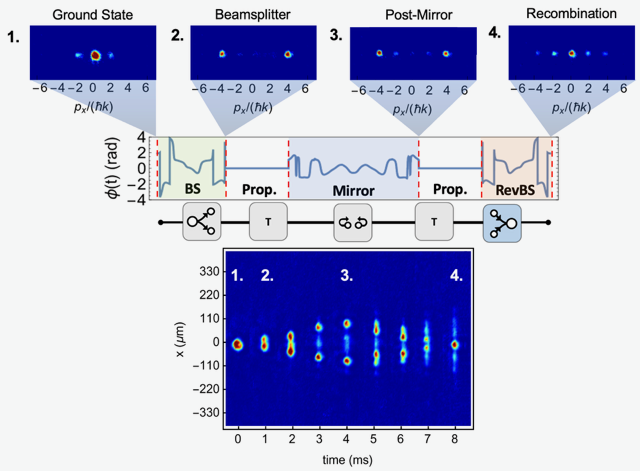
We are developing a precision atom interferometer based on loading a Bose-Einstein condensate into a three-dimensional optical lattice. By translating this lattice in a controlled manner, we can implement all of the standard operations of atom interferometry: splitting, propagating, reflecting, and recombining a macroscopic quantum wave function. These atom-optic operations act as matter-wave gates: unitary transformations that can be optimized using modern artificial-intelligence techniques. In particular, we employ deep reinforcement learning as a central tool in our experimental design. The gate-set we realize is metrologically universal, analogous to universal gate-sets in quantum computing, and therefore is capable of sensing arbitrary signals. We confirm the designed operations experimentally through in situ imaging of the condensate’s spatial evolution within the lattice, as well as through measurements of momentum-state populations after time-of-flight expansion. We further demonstrate applications to several fundamental quantum-sensing circuits, including those used to measure inertial forces, rotation, and gravity gradients. We refer to our sensor as a Bloch-Band Interferometer (BBI) because it manipulates atoms between the lowest Bloch eigenstates in the valence band, where atoms are effectively frozen, and the high-lying Bloch states in the conduction band, where atoms propagate over long distances as effectively free particles. This capability enables us to enclose large interferometric areas in a tiny sensor and thereby achieve high metrological sensitivity, and to do this in multiple dimensions simultaneously. Realizing such large areas requires long interrogation times; to support these durations, we “paint’” tailored optical potentials onto the lattice to emulate a microgravity environment on Earth. In this talk, I will report recent progress on the experiment, as well as developments in the accompanying theory and machine-learning methods.
-

Harnessing AI to Perform Multidimensional Inertial Sensing in an Optical Lattice
We are developing a precision atom interferometer based on loading a Bose-Einstein condensate into a three-dimensional optical lattice. By translating this lattice in a controlled manner,… (more)
-
Murray Holland
Professor at the University of Colorado Boulder and Fellow – JILA (more)