

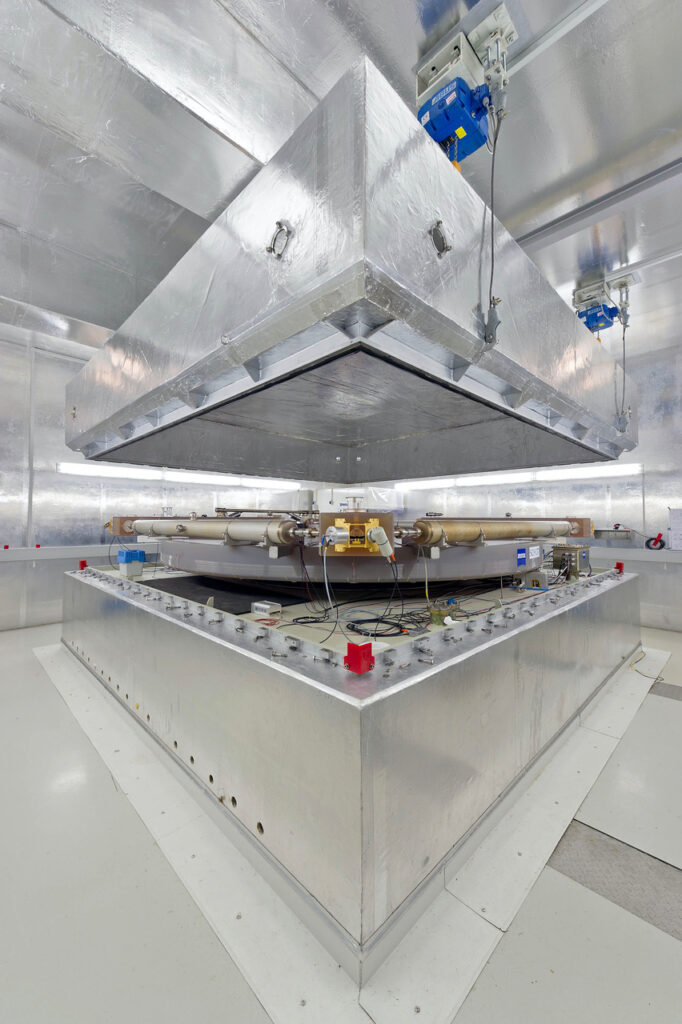
Ring lasers are now resolving the rate of rotation of the Earth with 8 significant digits. Technically they constitute a Sagnac interferometer, where a traveling wave resonator, circumscribing an arbitrary contour, defines the optical frequencies of two counter-propagating resonant laser beams. Subtle non-reciprocal effects on these laser beams however, cause a variable bias, which reduces the long-term stability. Over the last two years, we have improved the performance of the G ring laser at the Geodetic Observatory Wettzell to the point, that we obtain long-term stable conditions over more than a year. Advances in the modeling of the non- linear behavior of the laser excitation process as well as some small but significant improvements in the operation of the laser gyroscope are taking us now right to the point, where the periodic part of the variable Earth rotation amounting to less than 1 ms in the Length of Day (LoD) can be recovered.
Since a ring laser gyroscope is an inertial sensor, it is sensitive to the precession of the earth rotation axis. This corresponds to a continuous motion of 50 seconds of arc per year. It is the first time that this has been observed by an inertial sensing technique. A laser gyroscope is a local sensor, but we extract a global quantity from it. How accurate are these measurements and where are the persisting error sources? This talk outlines the current state of the art of inertial rotation sensing in the geosciences and points out where the remaining challenges lie. Furthermore, we discuss promising ways for an improved sensor stability.